Recumbent Knee Flexor Stretch Exercise Images
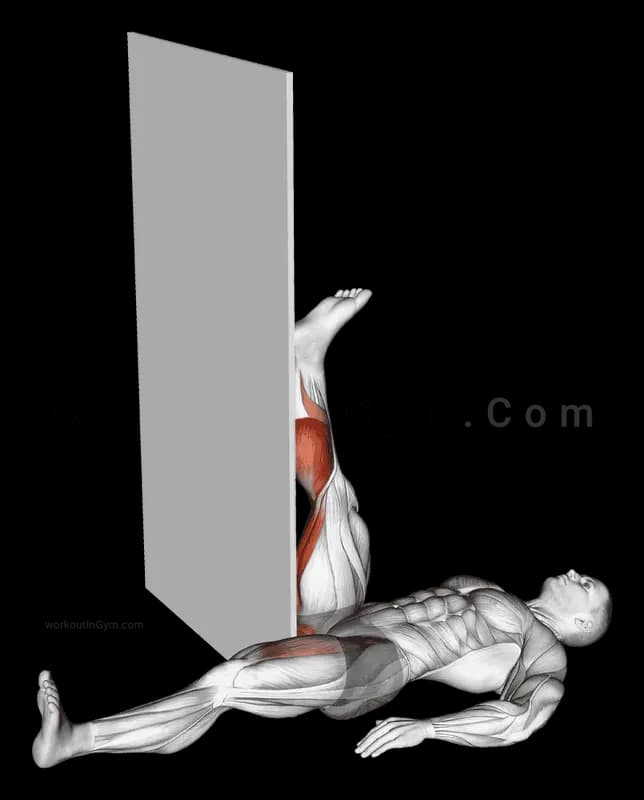
Showing step 1 of 1
Recumbent Knee Flexor Stretch
Target Muscles
Primary:
Equipment Required
Exercise Type
Time (Seconds)
How To Do
Lie on your back with one leg straight and the other bent, placing the heel of your bent leg against a wall. Gently push your hips toward the wall until you feel a stretch in the back of your thigh. Keep your lower back pressed into the floor for proper alignment.
Step-by-Step Instructions
- Lie on your back with one leg straight and the other leg bent.
- Place the heel of your bent leg against a wall or other vertical surface.
- Gently push your hips towards the wall until you feel a stretch in the back of your thigh.
- Hold the stretch for 30 seconds.
- Repeat on the other side.
Related Exercises
Explore more lower legs exercises or bodyweight exercises in our exercise library.
Alternative Exercises


Frequently Asked Questions
- What muscles does the Recumbent Knee Flexor Stretch target?
- This stretch primarily targets the knee flexors and muscles in the lower legs, particularly the hamstrings and calf region. It focuses on improving flexibility and mobility of the posterior chain, which supports better leg movement during daily activities and workouts.
- Do I need any equipment for the Recumbent Knee Flexor Stretch?
- You only need your body weight for this exercise, although a wall or sturdy surface is required to anchor your foot for the stretch. If a wall isn’t available, you can use a door frame or a partner to help position your leg correctly.
- Is the Recumbent Knee Flexor Stretch suitable for beginners?
- Yes, it is beginner-friendly because it uses a gentle, controlled position that minimizes strain. Beginners should start slowly, holding the stretch for shorter durations and increasing the time as flexibility improves.
- What common mistakes should I avoid during the Recumbent Knee Flexor Stretch?
- Avoid arching your lower back or letting your hips lift off the floor, as this reduces the effectiveness of the stretch and can strain your lower spine. Also, do not push too forcefully stretch gradually to prevent muscle injury.
- How long should I hold the Recumbent Knee Flexor Stretch?
- Hold the stretch for 20–40 seconds and repeat 2–3 times per leg for best results. Gradually extend the duration as your flexibility improves, ensuring you maintain proper form throughout.
- Are there variations of the Recumbent Knee Flexor Stretch?
- Yes, you can adjust intensity by moving your hips closer or farther from the wall. Another variation is to use a resistance band around the bent leg to add a gentle pulling force for a deeper stretch.
- What are the benefits of doing the Recumbent Knee Flexor Stretch regularly?
- Regular practice can improve hamstring flexibility, reduce muscle tightness, and support healthy knee and hip function. It also helps recovery after lower body workouts by promoting blood flow and reducing soreness.